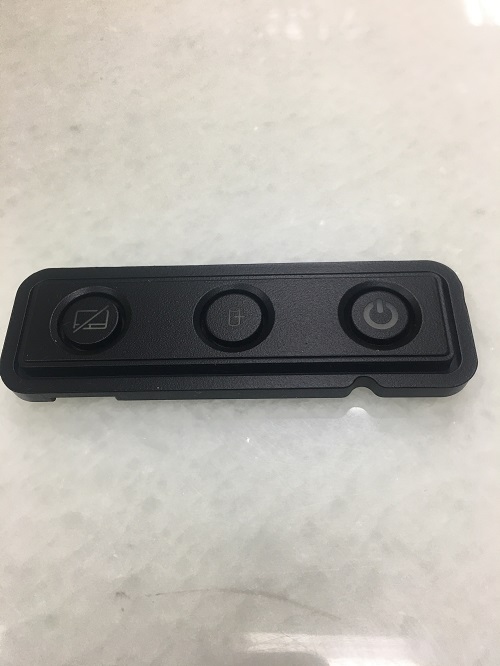
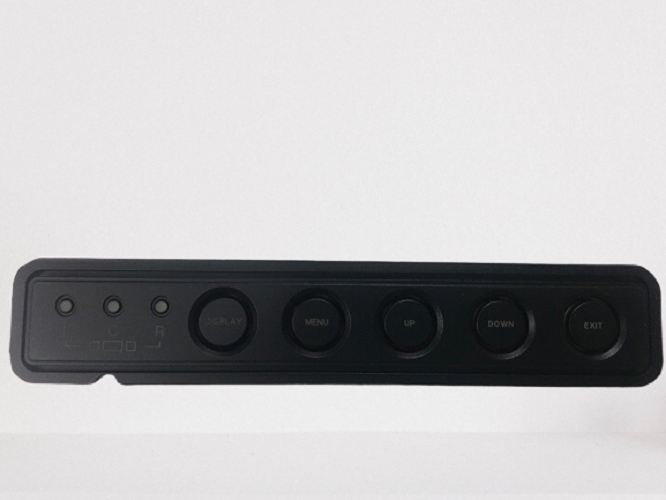
Printed silicone buttons Silicone buttons have a long life, with an average number of presses of more than 1 million times. Rubber buttons can be combined with flexible circuits or printed circuit boards.
Laser engraving or PU coating can be used on the surface of silicone buttons. Silicone buttons can be made into transparent sheets, which can have good light transmission when combined with LEDs.
The silicone keys have a slightly soft touch and can be easily peeled off with a knife. They are not afraid of water, acid, or detergents. This type of key is generally called a rubber silicone keypad, which is different from the plastic 'hard' keys on computer keyboards.
Rubber silicone buttons are widely used in remote controls, automobile industry or industrial instruments.
The material of rubber buttons is generally silicone (called 'silicone' in mainland China). When molding, take a piece of unripened silicone, weigh it to a certain extent, and place it above the lower die of the extrusion mold. The weight is very important. Controlling the weight is equivalent to controlling the volume of the silicone. If it is too heavy, it will overflow; if it is too light, it will be short of material and not filled enough. Then close the upper mold and the lower mold and heat it to about 150°C. After a certain period of time (usually less than 1 minute), the mold can be opened and the rubber button will be formed. However, at this time, there are still many edges and corners that need to be removed, and there is no printing yet, and there are no conductive particles yet.
The rubber buttons are not really finished yet! It is also necessary to add conductive pellets. The material of the conductive pellet is usually silicone plus conductive 'carbon', and the impedance requirement is less than 50 ohms. It can also be made of 'gold' (the impedance requirement is less than 10 ohms) or other conductive metal materials. The reason why carbon or gold is used as conductive particles is that they have good oxidation resistance and wear resistance. Of course, the characteristics of 'gold' are more suitable for use as conductive particles than 'carbon', but the price of gold is more expensive. Generally, consumer products with low durability requirements almost all use 'carbon', so in English they are mostly called 'Carbon Pill' to replace Conductive Pellet.
An excellent manufacturer specializing in manufacturing rubber and silicone accessories. The rubber and silicone materials provided have passed UL, SGS, RoHS, FDA, NFS, WRAS,... inspections. The rubber and silicone materials have passed international professional certification, and the rubber and silicone raw materials can withstand the test.
Sales method: Manufacturing, cooperation, export
sales Target markets: Taiwan, Mainland China, Hong Kong, Singapore, Global, Southeast Asia, Asia
Inquiry Payment method: TT Telegraphic
Transfer Competition Features
Unique designs or logos accepted: Special designs or LOGOs are accepted.
Suitable for promotional items or gifts.
Various designs: Junction (Rubber) Enterprise Co., Ltd. Provides diversified designs of printed silicone buttons.
Printed silicone buttons accept original factory commissioned design and manufacturing. ODM
printed silicone buttons accept original factory commissioned OEM manufacturing.